
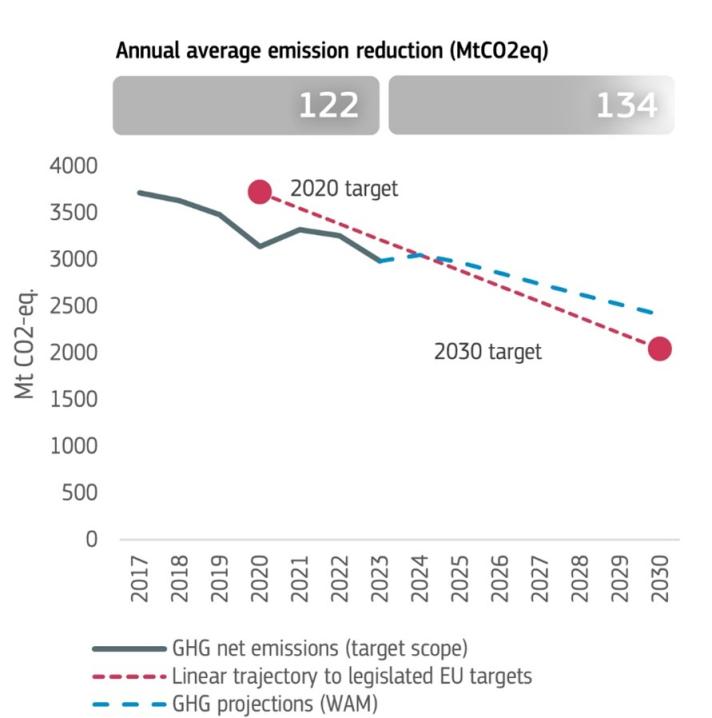
Here’s the thing, the headline is simple and blunt. Global greenhouse gas emissions climbed to roughly 53.2 gigatonnes of CO2 equivalent in 2024, up about 1.3 percent on 2023, while the European Union reported a decline of roughly 1.8 percent in emissions, excluding land use and forestry. That split is the Emission Pivot, and it matters because contrasts carry lessons.
Emission Pivot, how the shift happened.
Let’s break it down, the EU reduction is not a single policy or miracle, it is the result of several concrete moves lining up. Power generation shifted away from coal in several member states, renewables expanded where grid integration allowed it, and energy efficiency measures finally translated into lower consumption in buildings and industry. Those are measurable adjustments, not slogans, and they are the core drivers behind the Emission Pivot.

Emission Pivot, where the gains are concentrated.
What this really means is, the wins are clustered. The power sector shows the clearest reductions, and some energy intensive manufacturing subsectors have made real progress through fuel switching and process upgrades. Transport and agriculture did not fall at the same pace, and that disparity signals where the next hard work will be. The Emission is substantial, but uneven, and the unevenness defines the policy challenge ahead.
Emission Pivot, market and policy consequences.

Here’s another point, the Emission Pivot will change incentives. Expect more public funding and private capital to target grid upgrades, storage, electrification, and low carbon industrial technology. Expect clearer regulatory signals around reporting and performance, which will shift corporate planning and investor due diligence. Firms that plan for the Emission will find fewer surprises and lower transition costs, firms that delay will face faster, harsher corrections.
Emission Pivot, lessons for communicators and educators.
If you make content, use tension, not triumph. Open with the global number to create urgency, then pivot to the EU example to show a practical path, and close with concrete takeaways. Three useful takeaways are policy clarity, investable technology pathways, and measurable performance metrics. Frame the Emission Pivot as evidence that targeted approaches work, while making plain the limits and the hard sectors that still need attention.
Emission Pivot, practical actions to highlight.
What this really means for local leaders and practitioners is actionable. Cities can prioritize building retrofits and grid flexibility, industry can accelerate electrification in feasible processes, and transport policy can focus on freight modal shifts and fuel standards. Those are not abstract. They are steps that reduce emissions, create jobs, and lower long term costs. The Emission Pivot shows where practical, near term wins are likely to be found.
Emission Pivot, how to avoid the hype.
Do not present the Emission as an endpoint. It is a directional change, an illustration of what policy plus investment can do. Avoid triumphalism, and avoid fatalism. The story is, the EU is bending its curve, the world is not, and the gap between the two is where the lesson sits. That is the honest framing that keeps the debate useful.
Emission Pivot, investors and innovators note.
The Emission Pivot changes risk calculus, because policy clarity in the EU makes certain green investments easier to price. Grid upgrades, storage, and industrial electrification are likely to attract capital, and that creates market signals for entrepreneurs. At the same time, transport and agriculture represent gaps where technology and policy must meet, which is where startups and investors should focus. In short, the Emission is both a report card and a roadmap for practical, fast action now today.
Emission Pivot, a final framing for action.
Ask one precise question at the end of your piece, for example, what one policy could your city implement this year that would cut emissions within five years. That question makes the Emission Pivot local and actionable. It turns an abstract statistic into a decision point. If you want this adapted into a 60 second script, a longer explainer, or a short slide deck with visuals and sources, tell me which format and I will produce it, tight, sourced, and ready to use.











Leave a Reply